
The (not-so) good old days—getting education as a blind student in South Africa

We often hear the joke from older folks today about how hard they had it in their school days—usually something about walking five miles to school every day through a foot of snow.

I didn’t have any snow in South Africa but I did get to struggle half-blind, through my schoolwork. In high school I had an embarrassing ugly pair of magnifying glasses which only focused when my nose was against the page.  Thankfully I sometimes had my friend, Marti, reading to me from our textbooks.  I couldn’t see the writing on the blackboard—yes in those days it was white chalk on a blackboard.  The learning trick was to memorize quickly after I finally figured out the print on the page.

Exam papers in high school were each three hours long. My principal got permission from the department of education to extend my exam session with another hour.  With my pitifully low vision I  couldn’t write on lined paper  and I was given blank pages  and a black pen so I could write as large as I needed  and see the contrast of the black ink against the white page.

My specialty was drama.  Till this day I thank my lucky stars for the school I attended and the teachers who recognized my ability in the theatre for they set my future career course.

On to the University of Pretoria

The requirements for university were three languages, Afrikaans, English and one foreign language, as well as science or math. I studied German and chose Math. Imagine math for someone who could hardly see! Somehow, someway I made it.

I was accepted at university and specialized in theatre.   Here it was the same situation—no aids, no Braille books, no books-on-tape, no talking computers just a constant barrage of text books I struggled to see to read.  Through the encouragement of teachers and professors I graduated but it was never easy. It was a constant struggle not only to study but also by now to pretend I saw things I didn’t.  In my country it was a shame to have a defect so I often found myself lying about my sight.

Today I’m happily, openly blind. It is so much easier socially to be totally blind.   Now I and others know I cannot see anything. Prior to total blindness I was never sure what I could see, perhaps a glimpse of something, or if the light was right more of something. If I didn’t know what I saw, how could I communicate to others what I could and couldn’t see. I’m pleased to take assistance in any way I can such as taking someone’s arm for sighted guidance.  Today I’m not tied up with pretending to see, my energy goes to performing speaking and writing.  My ultimate joy is the accessibility of information through all the latest devices and aids for the blind and I have become a reading fiend.
Educators for the Blind Conference

October 8-10, 2009, Macon Georgia

I performed my dramatic one woman show, Vibrations of Laughter -the story of Annie Sullivan, as a keynote before an appreciative audience of teachers for the blind. They graciously gave me a standing ovation. Actually two standing ovations, One for the Annie Sullivan and the other for the evening’s entertainment piece “Blind People Shouldn’t Vacuum” another one of my one-woman shows, sub-titled “An irreverent comedy.”

The next day during my talk on literacy I was interrupted by applause twice, once when I said, “Every morning when the American sun touches my cheeks I feel like blossoming because as a blind person In America I found so many opportunities and privileges.”  The next applause interruption came after my statement, “Today there is no reason to be blind and dumb.” I went further to explain what I meant by the word dumb—not to be educated enlightened and informed. For though blind people cannot see to read,   there is an amazing array of aids to make text accessible for reading, writing and research. Each one of these marvelous teachers was there to learn more about the latest technology and how to assist their students.

The exhibitors displayed talking software, voice activated software, sound screen savers, the latest in Braille and large print. As an example of what a visually impaired student can have today, a large flat screen with a camera was on display. The student can point the camera at a smart board and see what has been written on the smart board enlarged on the flat screen in front of the student. With a specialized pen the student can even take tests on the screen.  I drooled over all the aids that make learning so much easier than in my days as a student in South Africa. (I think I’ll follow this post with one on going to school blind in the old days in South Africa.)

When I speak to school children I say I wrote my book See the Ocean with my ears. I continue to explain how voice output software made it possible for me to become a writer speaker and performer. As I met the teachers for the blind and visually impaired at the conference my heart rejoiced over the work they do to uplift and educate those who need it most.

I repeat, each morning when the American sun touches my cheeks, I feel like blossoming.

Sunday Morning Float

October 11, 2009

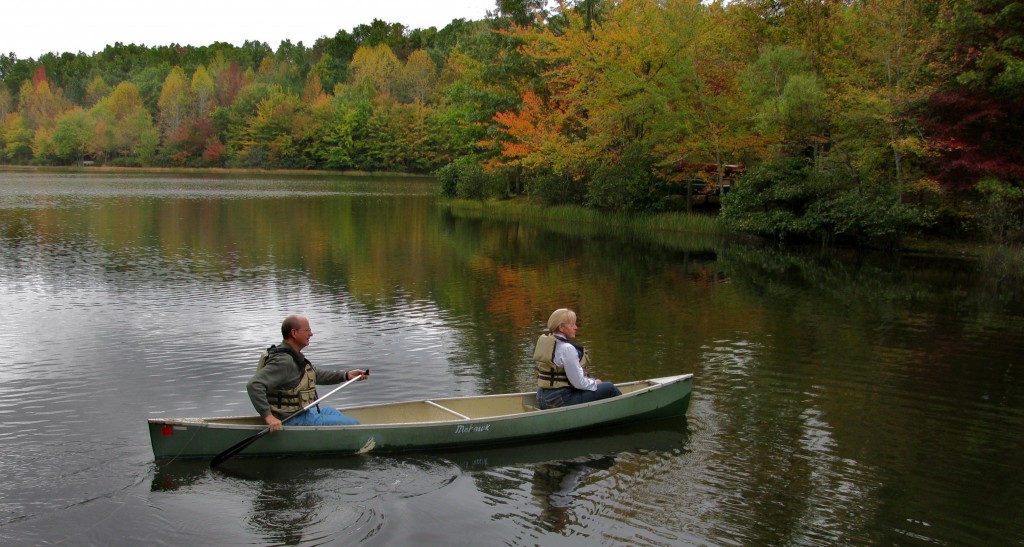
We canoe over red and gold fall reflections on a mirror calm lake

Under a blue-bonnet sky full of crow calls and little bird twitterings

Through olfactory sensations of bacon and maple syrup from the shore

I’m ferried Cleopatra-like by my husband

Across shiver shadows and sun fingers

We glide to old friends

On the porch of the hilltop getaway

For coffee and sweet remembrances.